
Show summary Hide summary
- Pilot begins: tolls handled inside Volvo’s Google-powered infotainment
- How the in-car payment process works
- Companies powering the experiment
- Why toll authorities and automakers are interested
- What Volvo plans and industry openness
- Global precedents: embedded payments already in use
- Early use cases and future possibilities
- Questions for broader adoption
- Why tolls are a logical first step
Volvo drivers in North Carolina are about to test a new way to pay tolls — no transponder required. The automaker, a state turnpike authority and major payments firms are teaming up to move toll collection into cars’ infotainment systems. The pilot could reshape how drivers pay on the move.
Pilot begins: tolls handled inside Volvo’s Google-powered infotainment
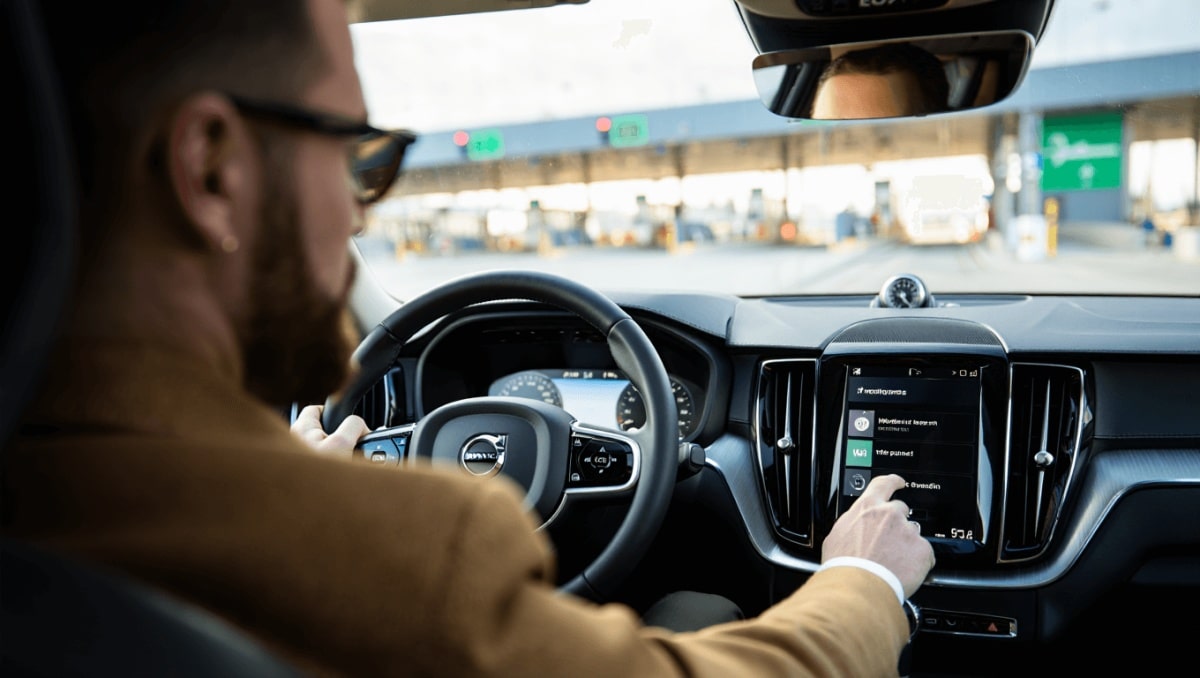
On Nov. 20, a limited test will let up to 100 Volvo owners pay tolls using the vehicles’ Android-based infotainment. Instead of an external transponder, drivers will enter a payment card into the built-in system. When the car is geolocated at a toll point, the tokenized card will be charged directly.
Elon Musk says Tesla owners can soon text and drive: rollout in a month or two
Nissan’s game-changing solar EV steals spotlight: 4 more EV stories this week
This replaces the need for prepaid transponder accounts during the trial. The North Carolina Turnpike Authority (NCTA) will receive approved payments and reconcile license plate records in its back office.
How the in-car payment process works
The mechanics are straightforward and built on familiar digital-payment building blocks.
- Drivers add card details into the Google Android infotainment app.
- Card data is tokenized to protect sensitive details.
- The embedded system geolocates the vehicle when it passes a toll gantry.
- Mastercard processes the transaction and notifies the turnpike authority.
Tokenization and direct charging mean fewer moving parts than the current transponder model.
Companies powering the experiment
Volvo Car USA and the NCTA are leading the pilot. Mastercard will process payments and route approvals. Several tech and services firms are involved as collaborators.
- Mastercard — payment processing and routing
- Microsoft — technology support
- Red Hat — software infrastructure
- Cognizant — systems and services integration
Any Volvo equipped with the Google infotainment platform is eligible. That software arrived on some models in 2022 and became standard across Volvo’s line in 2023.
Why toll authorities and automakers are interested
NCTA leaders argue embedded vehicle payments solve multiple issues with today’s tolling systems.
- Radio-frequency congestion: Transponders use bands prone to interference.
- High infrastructure costs: Gantries, sensors and upkeep are expensive.
- Reliability: In-car systems can leverage precise geolocation and account data.
The NCTA says shifting to in-car payments could save tens of millions on infrastructure. Those savings could be redirected toward road repairs and other projects.
What Volvo plans and industry openness
Volvo is building the tolling app and has said it will offer the software free to other automakers that use Google’s infotainment. That could simplify deployment across brands that share the platform.
- Volvo’s app aims to be cross-manufacturer, not isolated.
- Potential partners include Ford, General Motors, Honda and Nissan — all automakers that use Google in some models.
Volvo’s team emphasizes one common app is more efficient for highway authorities.
Global precedents: embedded payments already in use
Automakers in Europe have already rolled out embedded payments in specific markets. Mercedes-Benz customers in Germany can use in-car systems to pay at roughly 3,600 fuel stations. BMW offers similar functionality to about 500,000 drivers there for pumps and parking meters.
Those rollouts show how in-car payments can expand beyond tolling into fuel and parking services.
Early use cases and future possibilities
The pilot’s initial focus is tolling. But officials and industry leads envision a broader playbook.
- Parking garages and meters
- Car washes
- Drive-thru orders
NCTA leadership estimates wider adoption could become common within five years. Volvo executives also note that removing transponders might allow new windshield treatments that today interfere with transponder reads.
AI and a hands-off payment future
Mastercard describes a long-term vision where embedded payments link with in-car artificial intelligence. A vehicle could place an order at a coffee shop timed to the driver’s arrival and handle payment automatically.
“You just pull up, your car has already taken care of the order and the payment,” a Mastercard mobility lead said, painting a picture of convenience tied to geolocation and predictive timing.
Questions for broader adoption
Several practical and commercial questions remain before in-car payments scale nationally.
- Will other automakers adopt the same app or build proprietary solutions?
- How will privacy, tokenization and data-sharing be governed?
- Will existing toll operators accept direct card charges in place of transponder-based accounts?
Some manufacturers did not comment on their plans. For others, the priority is improving the customer experience and targeting transactions that happen while the vehicle is in motion.
Why tolls are a logical first step
Tolling is a natural initial use case because the transaction occurs as the vehicle travels. That reduces friction and demonstrates the technical reliability of geolocation-based billing.
If tolling proves robust, embedded payments can expand to many mobility services.

![Elon Musk claims Tesla owners can soon 'text and drive' with upcoming features: '[Within] a month or two'](https://www.kiheigas.com/wp-content/uploads/2025/11/Elon-Musk-says-Tesla-owners-can-soon-text-and-drive-scaled.png)


