
Show summary Hide summary
Buckle up: the Czech Republic is about to hit the fast lane—carefully. For the first time in EU history, a highway speed limit experiment is set to let drivers reach 150 km/h under specific, tightly controlled conditions. Gentlemen (and ladies!), start your engines—but keep your eyes glued to those dynamic signs.
A New Era: Czech Republic’s Cautious Speed Leap
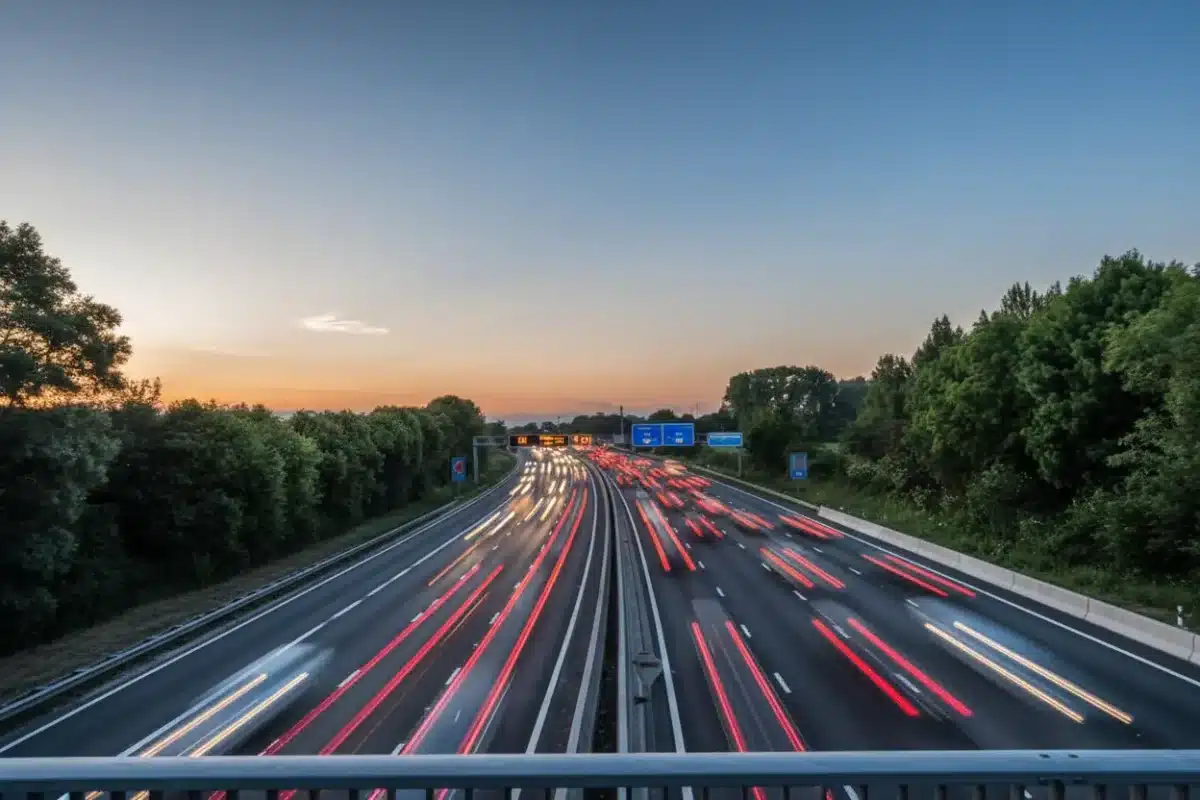
The Czech Republic will become the first EU nation to officially trial a higher, regulated highway speed limit. This milestone isn’t about reckless pedal-to-the-metal joyrides: starting late September or October 2025, a roughly 50-kilometer stretch on the D3, between Tábor and České Budějovice, will feature a dynamic speed limit system. Some 42 smart boards will mark the highway—so don’t bother trying to sneak past them!
This experiment is as much about prudence as it is about pace. The new 150 km/h limit isn’t a permanent fixture: it’s only in place when weather conditions are ideal and traffic is light. If things get wet, crowded, or workers are spotted on the roadside, the limit instantly snaps back to a more familiar 130 km/h. Talk about a quick mood change!
Elon Musk says Tesla owners can soon text and drive: rollout in a month or two
Nissan’s game-changing solar EV steals spotlight: 4 more EV stories this week
Under Strict Control: How the Czech Test Will Work
According to RTL Nieuws, the launch of this new regime is scheduled for the end of September or October 2025. The Czech trial comes with no shortage of strings attached. As AutoRAI emphasizes, this is merely a testing phase, confined to a specific corridor, and the elevated speed applies only if the sun is shining and the highway is virtually yours. It’s like being invited to a fast-driving party—except you’ll be turned away unless you’re impeccably dressed (in this case, unless the conditions are impeccable).
- 42 dynamic signs will control speed limits along the route.
- The 150 km/h limit will only show up during light traffic and dry weather.
- At any sign of congestion, construction, or rain, the cap returns immediately to 130 km/h.
- Further expansion of the scheme will only be considered if the first phase proves successful, according to Autovisie.
The Czech approach stands in contrast to Austria’s past attempt, where a 140 km/h trial was halted due to environmental concerns. Instead of pulling the plug preemptively, the Czechs hope that their dynamic sign system and strict criteria can curb potential risks before they even have a chance to pick up speed.
Context: Europe’s Speed Debates and Different Priorities
This isn’t happening in a European vacuum. Other countries are still trying to strike the magic balance between pace, safety, and emissions. The Netherlands, by comparison, is much less obsessed with raw speed. There, daytime limits are set to a uniform 100 km/h—except for a few custom stretches where drivers can tap up to 130 km/h throughout the day.
Earlier this year, NOS revealed that three Dutch segments—such as the Afsluitdijk and part of the A6—would allow the 130 km/h speed limit all day long. It’s a sign the Dutch are less about the thrill of top speed and more focused on predictability and customisation where possible. So, if you’re a Dutch commuter yearning for a taste of Autobahn-level adrenaline, looks like you’ll need to head east.
What Drivers Need to Know: Staying Smart in the Fast Lane
Planning a road trip through the Czech Republic? Prepare to swap habits: you’ll need to pay close attention to both your car’s dashboard and the new dynamic signs outside. Speed limits could change more rapidly than you’re used to—faster than your reaction to spotting a speed trap, even. Cruise control and speed assist features can help, but in rental or company cars, make sure those alert settings are actually switched on before you hit the gas.
- Stay alert: Expect shifting limits, with 42 signs orchestrating the show.
- Tech is your friend: Leverage cruise control or modern speed assistants.
- Drivers of rentals or leased vehicles: Double-check those warning settings!
This cautious, data-driven experiment matches a broader shift seen across Europe, not just in the Czech Republic. The trend? ‘Situation-dependent speeds’. The Netherlands, for instance, adjusts its limits using electronic signs during rain, or lowers them near work zones—not boring but smart, as it leads to smoother traffic and less stress for everyone. The old belief that faster is always better? In 2025, it’s being overtaken by a new mantra: driving smarter is just more relaxing.
Bottom line: The Czech experiment is blending ambition with accountability. Whether you’re a speed enthusiast or a fan of cool, controlled commutes, one thing’s for sure: paying attention to your dashboard and those 42 dynamic signs is about to get a whole lot more exciting.

![Elon Musk claims Tesla owners can soon 'text and drive' with upcoming features: '[Within] a month or two'](https://www.kiheigas.com/wp-content/uploads/2025/11/Elon-Musk-says-Tesla-owners-can-soon-text-and-drive-scaled.png)


